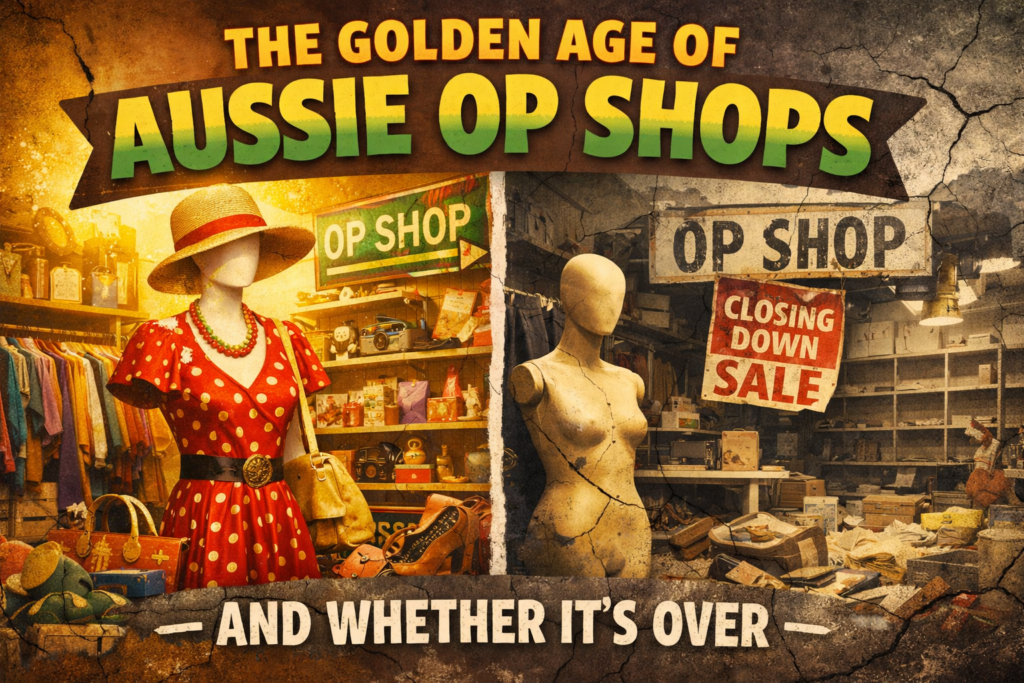
If you op shopped in Australia at any point during the late ’90s or 2000s, you probably remember a very different experience to what’s on offer today. The shops were messier. The pricing was almost comically low. Nobody was filming haul videos or flipping Le Creuset on Marketplace. You could walk into a Vinnies on a Saturday morning and leave with a bag of clothes for under ten dollars, a set of mismatched dinner plates for two, and a hardcover novel for fifty cents. It wasn’t trendy. It wasn’t curated. It was just cheap, strange, and quietly wonderful.
That era — if it ever had a name — is what a lot of people now think of as the golden age of Australian op shopping. And there’s a growing feeling among regular thrifters that it’s slipping away. Prices are climbing. Stock is being sorted and cherry-picked before it hits the floor. Some shops now look more like boutique vintage stores than the chaotic bargain caves they used to be. The question a lot of op shoppers are asking, sometimes with real frustration, is whether the thing they loved has fundamentally changed — and whether it’s still worth showing up for.
What Changed, and When
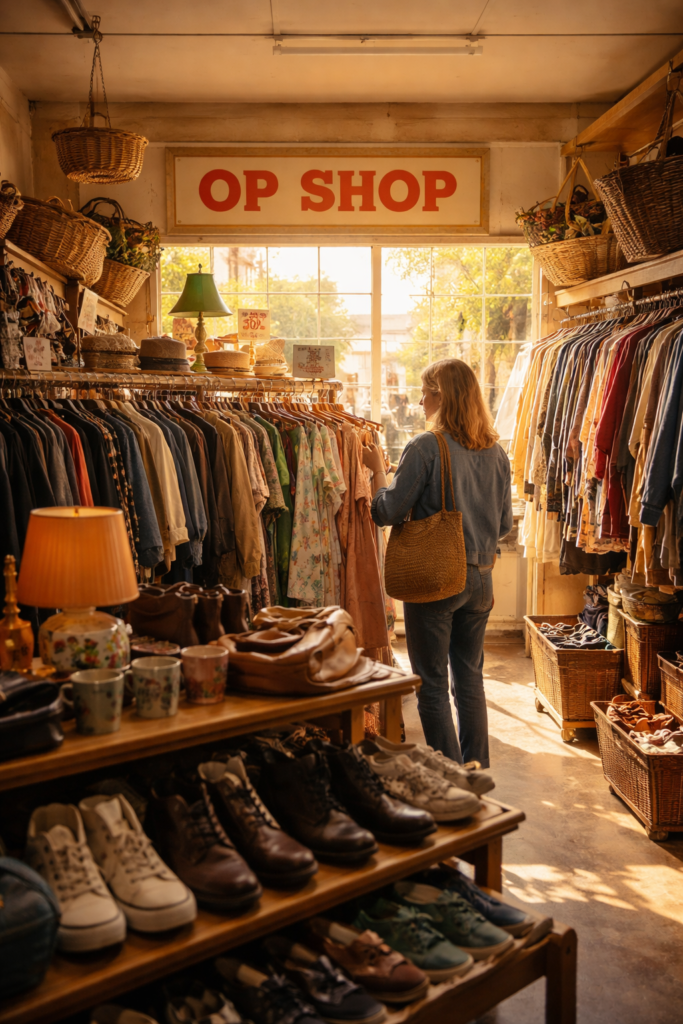
It’s hard to pin a single moment when op shops started to shift, but most people who’ve been paying attention point to somewhere around 2015 to 2018 as the tipping point. A few things converged.
First, thrifting went mainstream. Social media — Instagram initially, then TikTok — turned op shopping from a quiet habit into a visible lifestyle. Haul videos racked up millions of views. Influencers built entire personal brands around the aesthetic of secondhand shopping. Suddenly, op shops weren’t just for bargain hunters, pensioners, and uni students stretching a Centrelink payment. They were for everyone. And when everyone turns up, the dynamics change.
Second, the resale economy exploded. Platforms like Depop, eBay, and Facebook Marketplace made it easy and profitable to buy low at an op shop and sell high online. What had always existed on a small scale — the occasional dealer picking through stock — became a cottage industry. Some resellers were open about it. Others were less so. Either way, the best items started disappearing faster, often before the average shopper even knew they were there.
Third — and this is the one that stings the most for long-time op shoppers — the op shops themselves adapted. Major chains began investing in better merchandising, smarter pricing, and in some cases, separate “boutique” or “vintage” sections where higher-value items were pulled from the general floor and marked up significantly. Salvos launched their online store. Vinnies introduced curated fashion sections in selected shops. The days of a volunteer eyeballing a designer coat and sticking a $5 tag on it became rarer.
None of this happened overnight, and none of it happened everywhere at once. But the direction of travel has been consistent, and for a lot of shoppers, the cumulative effect is unmistakable.
The Pricing Conversation
Nothing generates more heat in op shopping circles than pricing. Scroll through any Australian thrifting group on Facebook and you’ll find the same debate playing out weekly: someone posts a photo of a $28 shirt at Vinnies, or a $45 jacket at Salvos, and the comments erupt.
On one side, people argue that op shops are supposed to be affordable — that their core purpose is providing low-cost goods to people who need them, and that hiking prices betrays that mission. On the other, defenders of the shops point out that these are charities, not discount retailers. Every dollar they make goes back into community services, crisis housing, disaster relief, mental health programs. If a donated designer handbag can fetch $60 instead of $8, that’s more money for people who genuinely need help.
Both sides have a point, and the tension between them probably isn’t going away. What’s harder to argue with is the lived experience of shoppers who’ve watched their local op shop go from reliably cheap to inconsistently expensive. When a secondhand cotton t-shirt is priced at $12, something feels off — not because the charity doesn’t deserve the money, but because the item simply isn’t worth that to a secondhand buyer. Overpricing doesn’t just frustrate shoppers. It slows down sales, clogs up racks, and can actually reduce the revenue a shop brings in.
The shops that get it right tend to price generously on everyday items — keeping basics cheap to maintain goodwill and turnover — while reserving higher prices for genuinely premium or collectible pieces. That balance is what made op shops work for decades, and the ones still striking it are the ones that still feel good to shop in.
What About the Stock?
Pricing isn’t the only thing that’s shifted. The quality of donated goods has changed too, and not always for the better.
Fast fashion has flooded the donation pipeline. Where op shops once received wardrobes full of well-made, long-lasting garments — the kind of clothes people kept for years and then passed on in good condition — they now receive enormous volumes of cheaply made, barely-worn items from Shein, Kmart, and Cotton On. These pieces clog up racks, require sorting, and often aren’t worth selling at any price. Some charities have spoken publicly about the cost of dealing with poor-quality donations, which in many cases end up going straight to textile recycling or landfill.
At the same time, the really good stuff — vintage clothing, quality homewares, solid furniture — has become scarcer on the shop floor. Some of it is being diverted before it gets there, sold through online charity stores or wholesale vintage dealers. Some of it simply isn’t being donated as often, because people now know what it’s worth and sell it themselves. The net effect is that the average op shop rack is heavier on disposable fashion and lighter on the kind of finds that made thrifting feel like treasure hunting.
That said, the good stuff hasn’t vanished entirely. It’s just harder to find, and it takes more patience and more visits to stumble across it. The golden age was partly defined by abundance — you didn’t have to work very hard to find something great. Now you do.
So Is the Golden Age Over?
Honestly? Probably, yes — at least in the way most people remember it. The combination of mainstream popularity, reseller culture, smarter pricing, and lower-quality donations has changed the landscape in ways that aren’t likely to reverse. You’re not going to walk into an inner-city op shop in 2026 and find a rack of untouched vintage wool coats priced at $4 each. That moment has passed.
But that doesn’t mean op shopping is finished, or that it’s no longer worth doing. It means the experience has shifted, and the shoppers who adapt to the new reality are still finding plenty to love.
The trick is knowing where to look. Suburban shops in middle-ring areas still turn up excellent stock at fair prices. Country town op shops — always a step behind the trends — remain some of the best-value secondhand shopping in the country. Smaller independent ops run by local churches and community groups are often the last places to adopt aggressive pricing, and they’re frequently overlooked by the crowds chasing the big chains.
It also helps to adjust expectations. If you go in expecting the effortless abundance of 2005, you’ll be frustrated. If you go in with patience, an open mind, and a willingness to visit regularly, you’ll still come home with things that surprise you. The thrill of the find hasn’t gone — it’s just spaced out a bit more.
What Stays the Same
For all the changes, some things about Australian op shops haven’t moved an inch. The volunteers are still overwhelmingly kind, often funny, and almost always up for a yarn. The shops still fund essential community services that most people never think about. The fitting rooms are still questionable. There’s still always one shelf of inexplicable ceramic figurines that nobody seems to buy but nobody ever throws away.
And there’s still that moment — the one every op shopper knows — when you slide a hanger aside and something catches your eye, and you pull it out and check the tag and feel a little jolt of disbelief. It doesn’t happen as often as it used to. But when it does, it feels exactly the same.
The golden age might be over. The good times aren’t.
Leave a Reply